
“He enjoys reading.” You pause, fingers hovering over the keyboard. It is report-writing season, and somehow, that phrase keeps turning up in every other comment. But you know that for some pupils, “enjoys reading” barely scratches the surface. For others, it feels downright untrue. Yet, with 30 more reports to write and no time to trawl back through the term, how are you meant to capture a child’s real journey with reading for pleasure? If you have ever found yourself frustrated by the gap between what you know about a pupil and the generic lines you end up writing, you are not alone.
When ‘Reading for Pleasure’ Feels Like Just Another Tick-Box
The Reporting Struggle: Noticing, Remembering, Articulating
There is a unique frustration in knowing that your class has made genuine progress with reading - buzzing about new books, recommending titles to each other, getting lost in stories during silent reading - yet when it comes to writing reports, you end up defaulting to the same tired phrases. The pressure to capture something meaningful, when your memory is a blur of “I’m stuck on this word, Miss!” and “Can I read just one more chapter?”, can feel immense.

A Familiar Frustration: Lacking Evidence Beyond ‘They Enjoy Reading’
Does that really do justice to the child who secretly reads under the table during maths, or the one who finally finished their first book cover-to-cover? With the number of pupils qualifying for free school meals doubling the national average in some schools, and enjoyment of books among UK children at its lowest in two decades, the need to make our reporting meaningful (not just compliant) has never felt sharper.
Imagining the Difference: What Effective Reporting Looks Like
How Specific Comments Can Transform Reports and Motivation
What if your report comments could actually reflect the spark you have seen in the classroom? Think of the impact on parents, on senior leaders, and - most importantly - on the pupil when they read a personalised sentence that captures their journey. When you move from generic to specific, you not only communicate progress, you remind everyone (including yourself) why these moments matter.
Before & After: Bringing Reading Participation to Life
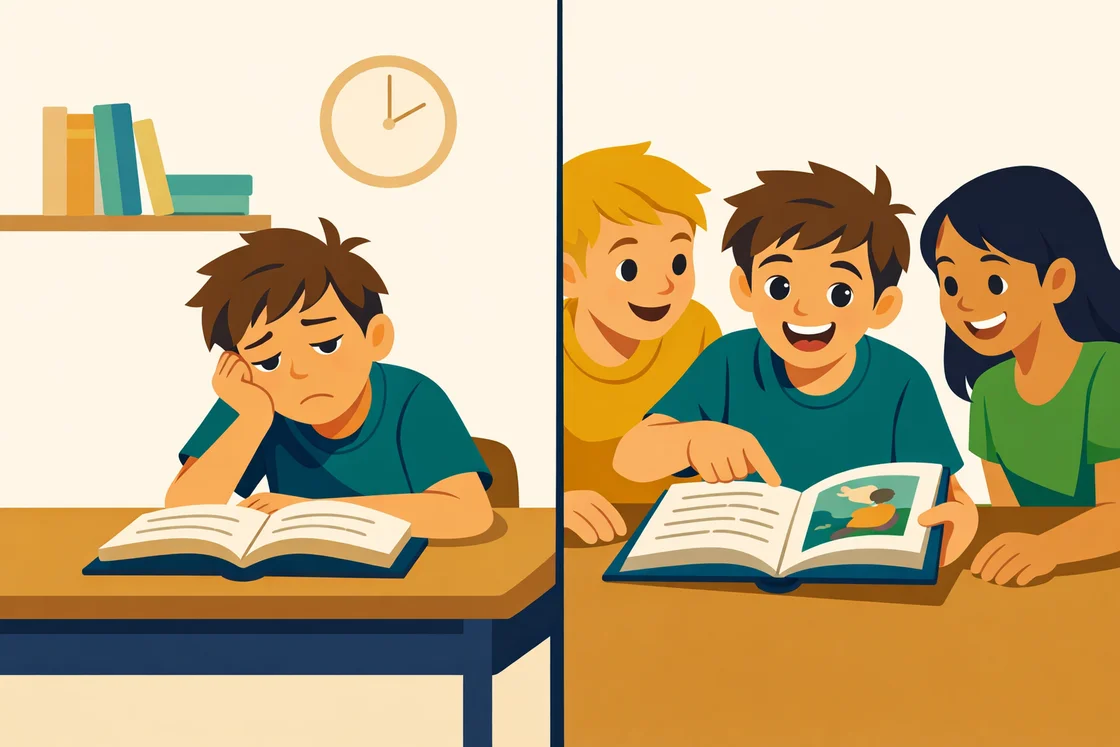
| Before | After |
|---|---|
|
“Ava enjoys reading and completes set tasks.”
|
“Ava has developed a real curiosity for adventure stories this term, eagerly sharing her thoughts about the characters in our class book. She often recommends new titles to her peers and is increasingly confident in choosing books independently.”
|
|
“Jay participates in reading sessions.”
|
“Jay has grown in confidence, moving from listening quietly to actively joining in group discussions about favourite authors. He now volunteers to read aloud and recently finished his first graphic novel with pride.”
|
Small changes, big difference. The second column gives parents - and the pupil - something to feel proud of. It also gives you evidence of your impact as a teacher.
Step 1: Observe Engagement in Real Time
What to Look For: Behaviours that Signal True Engagement
Forget abstract “reading for pleasure” statements. In reality, you spot engagement in the smallest moments: a pupil swapping books with a classmate, a hand shooting up to talk about a plot twist, or a reluctant reader quietly asking for more time to finish a chapter. Notice:

- Who recommends books to others?
- Which pupils ask to borrow books to take home?
- Who volunteers for reading aloud (or chooses to listen with focus)?
- Who brings up characters or stories in unrelated lessons?
- Who records their reading in journals, or even doodles about books in the margins?
Look for the signs that go beyond compliance - those little signals that a child is genuinely connecting with stories.
Quick Capture: Efficient Note-Taking Methods During Lessons
Of course, you do not have time to write an essay for every child during a busy lesson. But you can jot down quick observations on a sticky note, your planner, or a class list. Some teachers use:
- Simple codes (e.g. “R+” for recommended a book, “RA” for read aloud, “Q” for asked a question about the text)
- A rolling Google Doc or spreadsheet with a column for “reading engagement moments”
- Voice notes on your phone after class, if allowed
These snippets become gold dust when you sit down to write reports. And if you use a tool like Report Alchemy, you can upload these notes and generate detailed, specific comments in seconds - no more scrolling through memory for evidence.
Save Hours on Report Writing
Report Alchemy generates personalised, high-quality student reports in seconds.
Try Report Alchemy FreeStep 2: Record with Purpose - Practical Strategies
Simple Tracking Tools (Paper, Digital, or Hybrid)
There is no single “right” way to track reading engagement - what matters is finding a method that fits your workflow. Some teachers swear by:
- A class roster with checkboxes for engagement behaviours (e.g., “chose a new book,” “discussed a story,” “shared a recommendation”)
- Sticky notes stuck to pupils’ desks or reading folders, collected weekly
- Quick digital forms (Google Forms, OneNote) filled in at the end of each reading session
Consistency is key. Five seconds after each session is better than a “perfect” system you abandon by week three.
Involving Students: Self-Reflections and Reading Journals
Ask pupils to reflect on their own reading habits. A weekly prompt (“What was your favourite part of this week’s reading? Did you try a new genre?”) in a reading journal can give you authentic evidence - and, more importantly, make reading for pleasure visible to the pupils themselves. You can even include a pupil quote in your report: “Lily said, ‘I never liked mysteries before, but now I want to read more!’”
Tip: UK teachers’ top 3 time-saving observation hacks:
- Keep a “reading moments” sticky note on your desk; jot down initials and a quick code as you spot something.
- Assign a pupil as “reading ambassador” each week to help note who recommends or borrows books.
- Snap a quick photo (with permission) of pupils engaged in reading, then use the image as a prompt when writing reports.
Step 3: Articulate Progress with Confidence
Using Evidence for Personalised, Impactful Comments
This is where the magic happens - turning those fleeting moments into report comments that matter. When you have specific evidence to hand (even a sentence or two per pupil), you can write with detail, accuracy, and confidence. For example:
Notice how this comment tells a story, shows growth, and gives a clear sense of the pupil’s relationship with reading this term.
Phrases and Sentence Starters for UK School Reports
If you are stuck for words, try these sentence starters adapted for British primary and secondary schools:
- “This term, [Name] has shown…”
- “[Name] regularly recommends books to peers and…”
- “It has been fantastic to see [Name]…”
- “[Name] engages thoughtfully with class novels, often…”
- “A highlight was when [Name]…”
- “[Name] is developing confidence by…”
- “[Name]’s enthusiasm for [genre/author] has…”
Use the evidence you have gathered to finish the sentence in a way that is true to the pupil you teach.
Step 4: Showcase Impact - Sharing with Students, Parents, and SLT
Communicating Growth and Next Steps Effectively
When you report in detail about a child’s reading journey, you give parents real insight: not just “yes, they read,” but “here’s what’s changed, and here’s what could happen next.” For senior leaders, this evidence is vital - especially in a climate where libraries are under-resourced and reading enjoyment is falling nationally. Use your reports to highlight both successes and next steps:
- “[Name] now chooses books independently and…”
- “Next term, encouraging [Name] to explore non-fiction could…”
- “A focus for [Name] will be joining in book club discussions.”
Celebrating Success Stories (Including a Mini Transformation Example)
Consider the case of Morgan, a Year 6 pupil who arrived in September declaring, “Reading is boring.” By spring, after a few well-chosen graphic novels and some gentle encouragement, Morgan was the first to volunteer for our new lunchtime book club. In the autumn report, the comment was:
By July, it read:
For a parent, that is more than a tick in a box. For Morgan, it is a record of transformation - and a reason to keep reading.
Helpful Resources and Next Steps
Further Reading: UK Guidance on Reading for Pleasure
If you are looking to deepen your approach, consider these practical sources:
- The Guardian: School children excited about reading again
- UKLA and BookTrust materials on creating a reading culture (search for their latest guidance)
- DfE Reading Framework for up-to-date policy advice
Printable Tools and Templates
Want a quick-start template for capturing reading engagement? Download our free “Reading for Pleasure Observation Template” - or save even more time by using Report Alchemy to turn your notes into well-phrased, evidence-rich comments.
And remember: Your observations do not have to be perfect or exhaustive. They just need to be real. By noticing, recording, and reporting on the moments that matter, you help pupils see themselves as readers - and show parents and leaders the difference you make every day.
This article was inspired by recent reporting from The Guardian.